Product Name:
Mouse Pituitary Adenylate Cyclase Activating Peptide (PACAP) ELISA Kit
Cat.#:
JL17323
Regulatory Status:
Alternative:
ADCYAP1; PRP-48; Pituitary Adenylate Cyclase Activating Peptide 1
Detection Method:
ELISA
Assay Type:
Sandwich
Detection Range:
7.8-500pg/mL
Sensitivity:
3.8pg/mL
Specificity:
This kit recognizes Mouse PACAP in samples. No significant cross-reactivity or interference between Mouse PACAP and analogues was observed.
Sample Type:
Tissue homogenates;cell lysates and other biological fluids
Assay Procedure:

Research Area:
Developmental Biology
Size & Price: 
Product Datasheets
Instruction: 
| PACAP
Pituitary adenylate cyclase-activating polypeptide(PACAP)is a protein that encoded by the ADCYAP1 gene.PACAP is similar to vasoactive intestinal peptide. One of its effects is to stimulate enterochromaffin-like cells. It binds to vasoactive intestinal peptide receptor and to the pituitary adenylate cyclase-activating polypeptide receptor.This gene encodes adenylate cyclase-activating polypeptide 1. Mediated by adenylate cyclase-activating polypeptide 1 receptors, this polypeptide stimulates adenylate cyclase and subsequently increases the cAMP level in target cells. Adenylate cyclase-activating polypeptide 1 not only is a hypophysiotropic hormone, but also functions as a neurotransmitter and neuromodulator.| Typical data
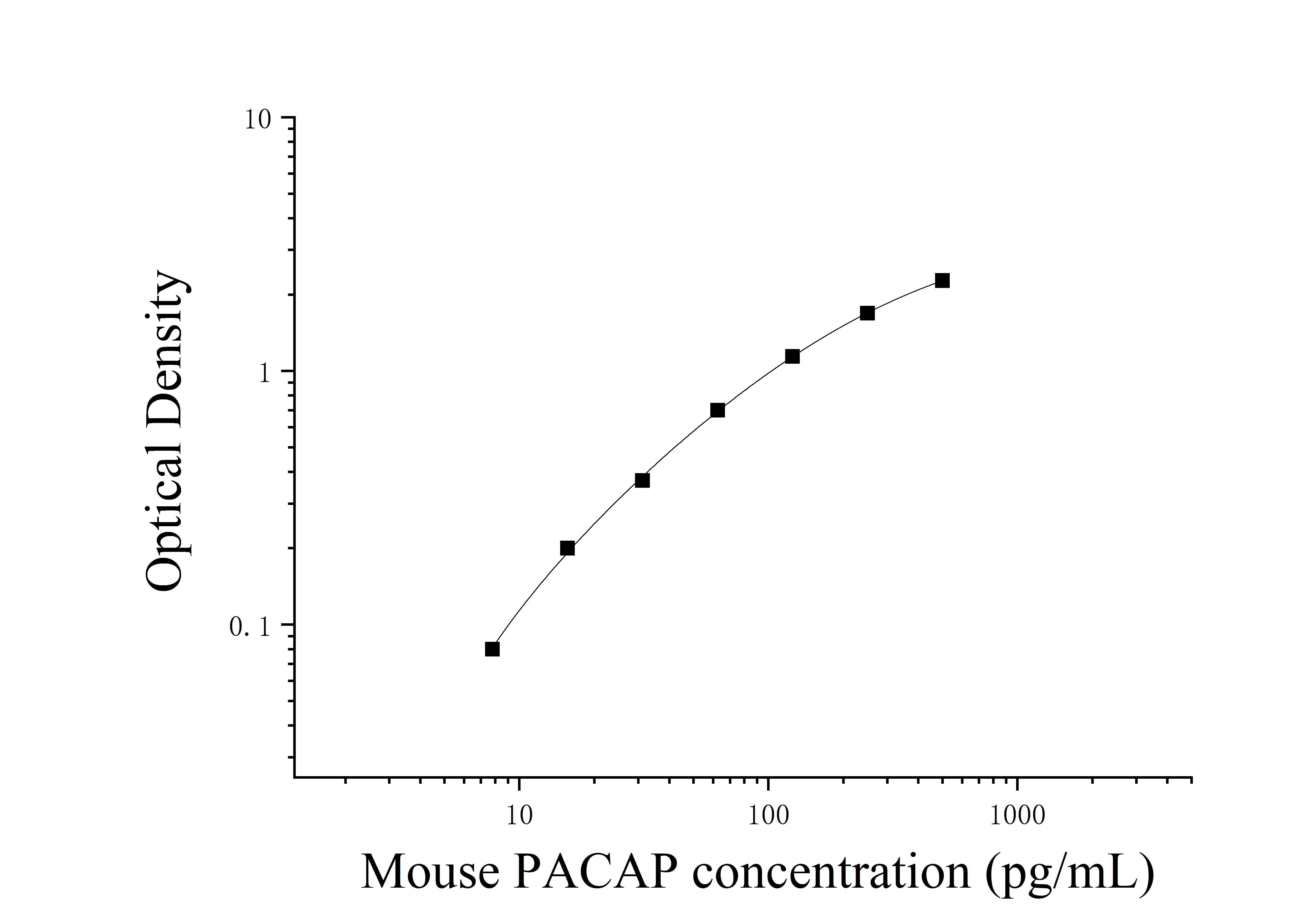
As the OD values of the standard curve may vary according to the conditions of the actual assay performance (e.g. operator, pipetting technique, wash technique or temperature effects), the operator should establish a standard curve for each test. Typical standard curve and data are provided below for reference only.| Concentration (pg/mL) | 500 | 250 | 125 | 62.5 | 31.2 | 15.6 | 7.8 | 0 |
| OD | 2.36 | 1.78 | 1.23 | 0.79 | 0.46 | 0.29 | 0.17 | 0.09 |
| Corrected OD | 2.27 | 1.69 | 1.14 | 0.7 | 0.37 | 0.2 | 0.08 | - |
| Repeatability
Intra-assay Precision (Precision within an assay):CV% < 10%; Inter-assay Precision (Precision between assays):CV% < 10%| Recovery
The recovery of Mouse PACAP spiked at three different levels in samples throughout the range of the assay was evaluated in various matrices.| Sample Type | Range(%) | Average Recovery(%) |
| Serum(n=8) | 84-101 | 96 |
| Plasma(n=8) | 92-105 | 102 |
| Tissue Homogenates(n=8) | 96-108 | 105 |
| Linearity
Samples were spiked with high concentrations of Mouse PACAP and diluted with Universal Diluent to produce samples with values within the range of the assay.| Serum(n=4) | Plasma(n=4) | Tissue Homogenates(n=4) | ||
| 1 : 2 | Range (%) | 84-95 | 88-96 | 90-110 |
| Average (%) | 91 | 93 | 96 | |
| 1 : 4 | Range (%) | 89-103 | 87-108 | 105-115 |
| Average (%) | 94 | 98 | 108 |
Related Product



Size
Quantity
Price ($)
48T
 1
1

280 / 280
96T
1
460 / 460